
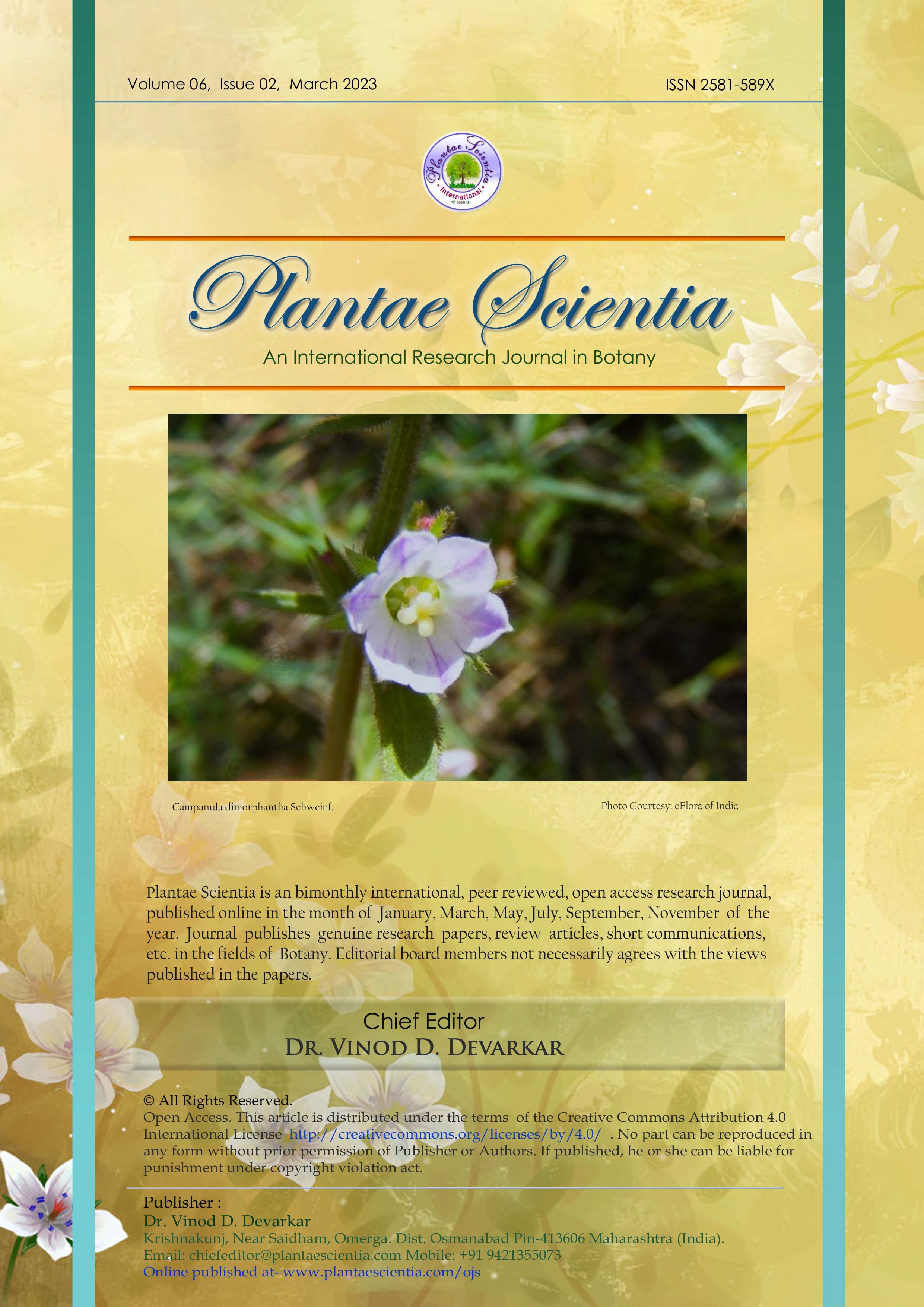
Campanula dimorphantha Schweinf. Additions to Angiosperm flora of Doaba region of Punjab, India
DOI:
https://doi.org/10.32439/ps.v6i2.4-6Keywords:
Angiosperm taxonomy,, Punjab, Doaba, Campanula dimorphantha Schweinf.Abstract
Campanula dimorphantha Schweinf. is documented first time from Doaba region of Punjab, India. This study will be useful for Botanists, taxonomists, researchers etc. for identification of species.
References
Borsch, T., Korotkova, N., Raus, T., Lobin, W. and Lohne, C. (2009). The petD group II intron as a species level marker: Utility for tree inference and species identification in the diverse genus Campanula (Campanulaceae). Willdenowia, 39 (1): 7-33. DOI: https://doi.org/10.3372/wi.39.39101
Contandriopoulos, J. (1984). Differentiation and evolution of the genus Campanula in the Mediterranean region. In Grant WF (Ed.) Plant biosystematics. Academic Press, Toronto, 141-158. DOI: https://doi.org/10.1016/B978-0-12-295680-5.50014-7
Fedorov, A. A. and Kovanda, M. (1978). Campanula Linnaeus. In: Tutin TG (Ed.) Flora Europaea, vol 4. Cambridge University Press, Cambridge, 74-93.
Hajra, P.K. & Sanjappa, M. (1996). Fascicles of Flora of India- Fasicicle 22. Botanical Survey of India, 144pp.
Haung, S.H. (1991). Campanulaceae. In: Wu, Z.Y. (Ed.) Flora Yunnanica, 5. Science Press, Beijing.
Hong, D.Y. (1983). Campanula Linnaeus and Adenophora Fischer. In: Hong D Y. (Ed.) Flora of Reipublicae Popularis Sinicae, 73 (2), Science Press, Beijing,
Hong, D.Y. (2015). Campanula Linnaeus. In: Hong D Y. (Ed.) Flora of Pan-Himalaya, 47. Science Press, Beijing, 292pp.
Kaur, K. (2021). Floristic Diversity of Dasuya Forest Division of Punjab: An area along foothills of Shivalik Range. Plant Archives, 21(2): 783-794.
Kaur, K., Sidhu, M. C. and Ahluwalia, A. S. (2017). Angiosperm diversity in Doaba region of Punjab, India. Journal of Threatened Taxa, 9 (8): 10551-10564. DOI: https://doi.org/10.11609/jott.2748.9.8.10551-10564
Khan, T. A. & Patil, U. K. (2020). Four Flowering plants are new distributional records from Satpuda range of Khandesh region, Maharshtra. International Journal of Botany Studies, 5 (1): 321-323.
Lammers, T.G. (2007). World Checklist and Bibliography of Campanulaceae. Royal Botanic Garden Kew.
Manhas, R.K., Singh, L., Vasistha, H.B. & Negi, M. (2010). Floristic Diversity of Protected ecosystems of Kandi region of Punjab, India. New York Science Journal, 3(4): 96-103.
Rawat, L., Manhas, R. K., Kholiya, D. & Kamboj, S.K. (2013). Floristic Diversity of Kandi region of Hoshiarpur, Punjab, India. Applied Ecology and Applied Sciences, 1(4): 49-54. DOI: https://doi.org/10.12691/aees-1-4-3
Sharma, G., Joshi, P.C., Kumar, K. & Vasu, D. (2009). Floral diversity and limnological studies in and around Dholbaha dam (Punjab Shivalik, India). Biological Forum- An International Journal, 1(1): 22-31.
Wang, T-T., Dang, Z-Y., Yang, F. & Wang, H-C. (2022). Campanula luzhijiangensis (Campanulaceae), a new species from Yunnan, southwest China. Phytokeys, 206: 49-59. DOI: https://doi.org/10.3897/phytokeys.206.87109
'WFO (2023): Campanula dimorphantha Schweinf. Published on the nternet; http://www.worldfloraonline.org/taxon/wfo-0000827059
Campanula dimorphantha - efloraofindia (google.com)
https://efloraofindia.com/2011/02/12/campanula-dimorphantha/
Downloads
Published
How to Cite
Issue
Section
License
Copyright (c) 2023 Rai Singh, Varinder Sharma

This work is licensed under a Creative Commons Attribution 4.0 International License.
1.gif) Ownership of Copyright Copyright License
Ownership of Copyright Copyright License View this website and the material on this website on a computer or mobile device via a web browser. You can copy and store this website and the material on this website in your web browser cache memory. You can print pages from this website for your use. All articles published by Plantae Scientia are licensed under the Creative Commons Attribution 4.0 International License. This permits anyone to copy, redistribute, remix, transmit and adapt the work provided the original work and source is appropriately cited. You suppose not to adapt, edit, change, transform, publish, republish, distribute, redistribute, broadcast, rebroadcast or show or play in public this website or the material on this website (in any form or media) without appropriately and conspicuously citing the original work and source or Chief Editor, Plantae Scientia prior written permission. Infringement If Plantae Scientia discovers that anyone have used its copyright materials, may go for legal proceedings against whomsoever concern, seeking monetary damages. You could also be ordered to pay legal costs. All the disputes will be solicited at Omerga Dist. Osmanabd jurisdiction. Permissions You may request permission to use the copyright materials on this website by writing to chiefeditor@plantaescientia.com





.gif) This work is licensed under
This work is licensed under 